
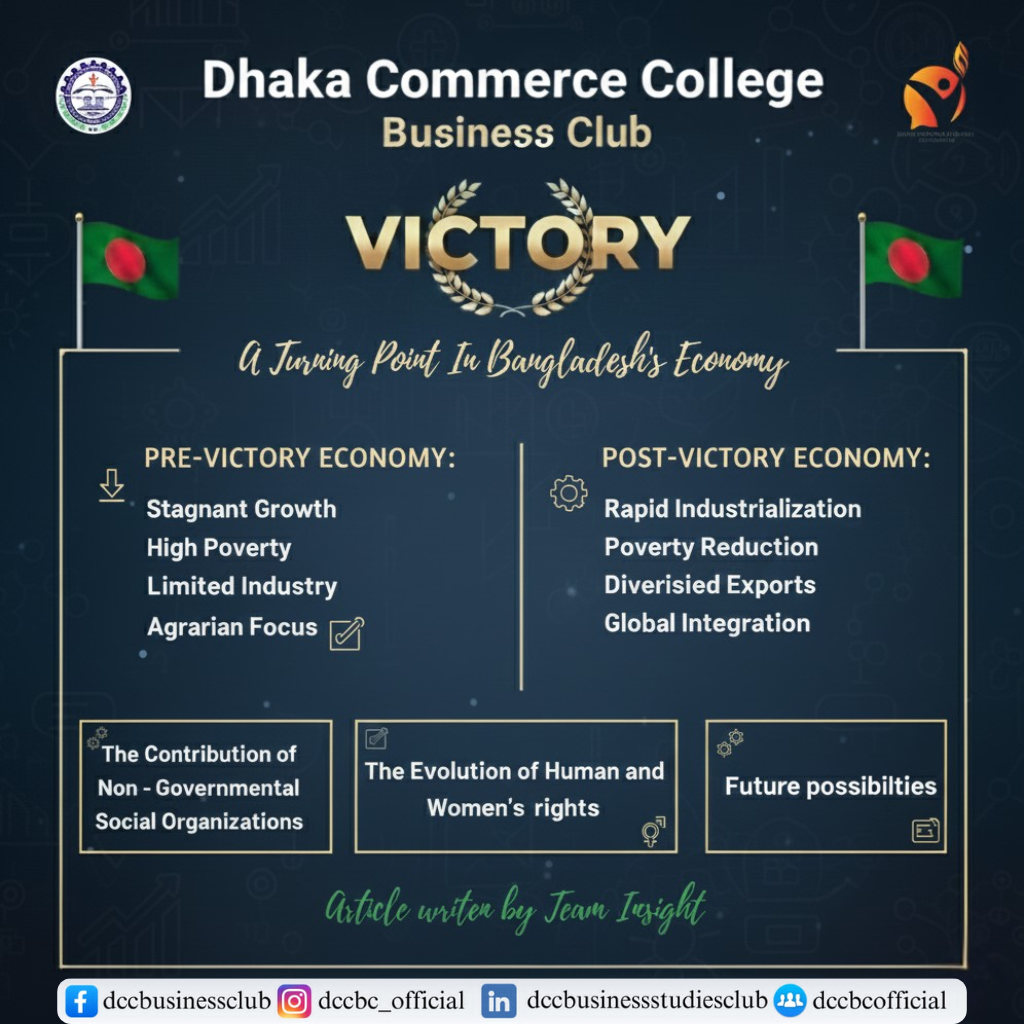
Written by: Team Insight (Hamzah Hossain Raiyan, Srijita Munsur Medha, Md. Maheen Ahmed, Nowshin Atia Raisa, Anita Ibanth Prithe)
All rights reserved by DCC Business Club.
Victory: A Turning Point in Bangladesh’s Economy
What is Victory:
What do we mean by victory? In common parlance, victory is the successful conclusion of a struggle, war, competition, or endeavor. We Bangladeshis got victory from Pakistanis. And through this victory we gain our final freedom. Freedom is the state of being free from control or subordination, granting us the power of self governance or self control. Through this victory we have gained freedom from everything. We got the freedom of speak, the freedom to dream, the freedom to build a strong economic nation.
Why the “Outside World” Idea Didn’t Work:
After the Liberation War in 1971, US Secretary of State Henry Kissinger called Bangladesh a “Bottomless Basket”. A negative comment on our fragile economy at the time. But we proved them wrong, and today our beloved Bangladesh is recognized as a developing country. We have been able to prove their comments wrong by pointing a finger at them. Now we are moving forward like a flowing river. We are contributing to the world’s major economies, such as clothing, which is being exported to major countries around the world. Bangladesh is now operating its own economy in many parts and has often given loans to other countries.
Economic Conditions Before and After Independence:
During the East Pakistan period, our economy was weak. Far from development, people were dying of hunger. In addition, Bangladesh had a big problem with low literacy rates, low income, and overpopulation. Towards the end of the liberation war, when the West Pakistanis realized that there was no chance of winning, they made our economy fragile, including killing talented people and looting. So that we can’t stand before the world with our heads held high. After the victory, Bangladesh started to turn around. In the face of various terrible dangers, we can share our Bengali identity with the womb. And the main means of this turnaround by trying, industrial development, especially the garment industry, which progress the wheels of Bangladesh’s economy. The literacy rate increased. New companies are established, resulting in an increase in the number of jobs. Banks and other financial institutions started their work in full swing. The result of which is today’s Bangladesh.
The Evolution of Human and Women’s Rights in Bangladesh:
On the East Pakistan period, human rights were crushed by the West Pakistan government. They ignored Bengali needs, stole resources and crushed protests, like killing students in the 1952 language riots. Women’s rights were the worst; women dealt with forced marriages, no education and traditions keeping them homebound, with no laws against abuse. This is the main reason why the economy suffered before our great victory.
But after the victory, the people of newly independent Bangladesh are creating history by their skills and contribution. They are working in many sectors and representing them as the proud Bengalis to the world. People got their basic human rights after the independence by which they started to progress, to build a new country and worked together to develop it from the destruction what Pakistan did. Women are getting inspection for work. They are starting to respect their rights and are contributing significantly for the development of the country through various economic activities.
Agricultural & Industrial development:
After the independence the industrial development took a massive turn. As for the agriculture, it’s the heart of the economy of Bangladesh. Before the independence, we Bengalis were tortured and controlled by the Pakistanis. Which is why our agriculture wasn’t that developed. But after we got separated from them, the new Bangladesh started to enhance its agriculture at a new level. People turned into skilled human resources to produce the Golden Paddy from the green land. As well as the garments where tons of clothes were made. We export these products causing the enlargement of Bangladesh economics. All of these opportunities and rights of common people to create and produce the goods, make our economic system progressively day by day.
Development of Banking and Financial Institutions:
During the time of east Pakistan, the banking system was characterized by concentration, lack of local control, and an urban focus. Central bank was the bank of Pakistan or by foreigners. Bangladeshi (East Pakistan) control was minimal banking services were heavily concentrated in urban areas, leading to very limited financial inclusion for the vast rural population. After independence the nation’s economy has changed and improved. The Dhaka branch of state bank of Pakistan (Central bank) was immediately designated and renamed as Bangladesh Bank. Banks were restructured into six state-owned Commercial banks like Sonali, Janata, Agrani. Also Krishi bank were established for the improvement of Agriculture and industries, expanding credit facilities to farmers and small businesses. And lastly the Grameen Bank, the unique banking model helped lift millions out of poverty in rural Bangladesh. Also, mobile money services like bKash, Nagad have expanded financial access and improved our daily lives and will help develop our future economy.
Changes in people’s Financial needs after Independence:
Before the victory Bengalis, as part of Pakistan, we were scraped by on basics like rice and tea, with money mostly going to survive floods and poverty. The big bosses in the west took most of the wealth, so saving for the future felt impossible. Then, independence hit. Suddenly, people needed cash rapidly for rebuilding. Families pooled money to fix broken houses or buy seeds for fields. Jobs were tough, so parents started saving for kids’ schooling, dreaming of better lives in cities. The government gave some help, but inflation made everything pricier like food, clothes etc. Thus, the financial needs became higher as well as the handout of the common people of Bangladesh. They are increasing their responsibility to build their mother land and making to worth the name ‘Sonar Bangla’.
Economic Development of Citizens (per capita income):
Economic journey for Bangladesh, transitioning from a war-ravaged country with extremely low income to one of the fastest-growing economies in the world. Before 1971 per capita income was very low (close to $100 or less). Immediately after victory (1971-72) it risen up to $100. During 2000-2020 it had a significant growth, the economy developed rapidly, driven by industrialization and the service sector. The current per capita income is higher than the initial post-independence period, signaling a profound economic transformation for the country. Ready-made Garments-industry sectors’ massive expansion has been the most important engine for export and industrial growth creating millions of jobs. Also Remittances sent home by expatriates, are a significant boost to national income. Also, the foreign trade and export have a massive role in this. It has surpassed neighboring countries like India and Pakistan. This is how we are improving our GDP.(Insource: Wikipedia)
The contribution of non-governmental social organizations:
Non-Governmental social organizations play an essential role in converting marginalized or less-skilled populations into valuable human assets for a nation. They provide essential technical and vocational education such as tailoring, handcraft, computer skills to the unemployed and uneducated people, especially in the rural and remote areas. To increase the literacy rates and educational success, they run non-formal and academic support, establishing schools where government infrastructure is lacking. Also, by growing entrepreneurship development through many trainings and mentorship, NGOs are pioneers in providing financial tools and opportunities to the peoples. Besides transforming recipients into contributors such as Microfinance Major NGOs like Grameen Bank, BRAC have revolutionized poverty reduction by providing small loans (microcredit) to the poor, especially women, which helps them to break the cycle of poverty.
Future possibilities:
We are proud of Bangladesh. The country we dreamed of and fought for 54 years ago. We have a lot of potential in this country. Our goal is to become a highly developed country by 2041. By using our digital economy and geographical location. The main source of potential has skilled young manpower and another is remittances. Every year our remittance warriors send a huge amount of foreign money which further strengthens our economy. Moreover, ensuring food securities and developing agro-based industries are making a major contribution. This potential also has many challenges, one of which is rising inflation and pressure on foreign exchange reserves. Our economy is overly dependent on the garment sector. Therefore, we need to reduce this dependence and make proper use of other sectors such as tourism and natural and mineral resources. We need to build the Bangladesh for the future while addressing the risks of climate change and ensuring sustainable economic growth. So that in the future, people from other countries will say that we have to be like Bangladesh.