
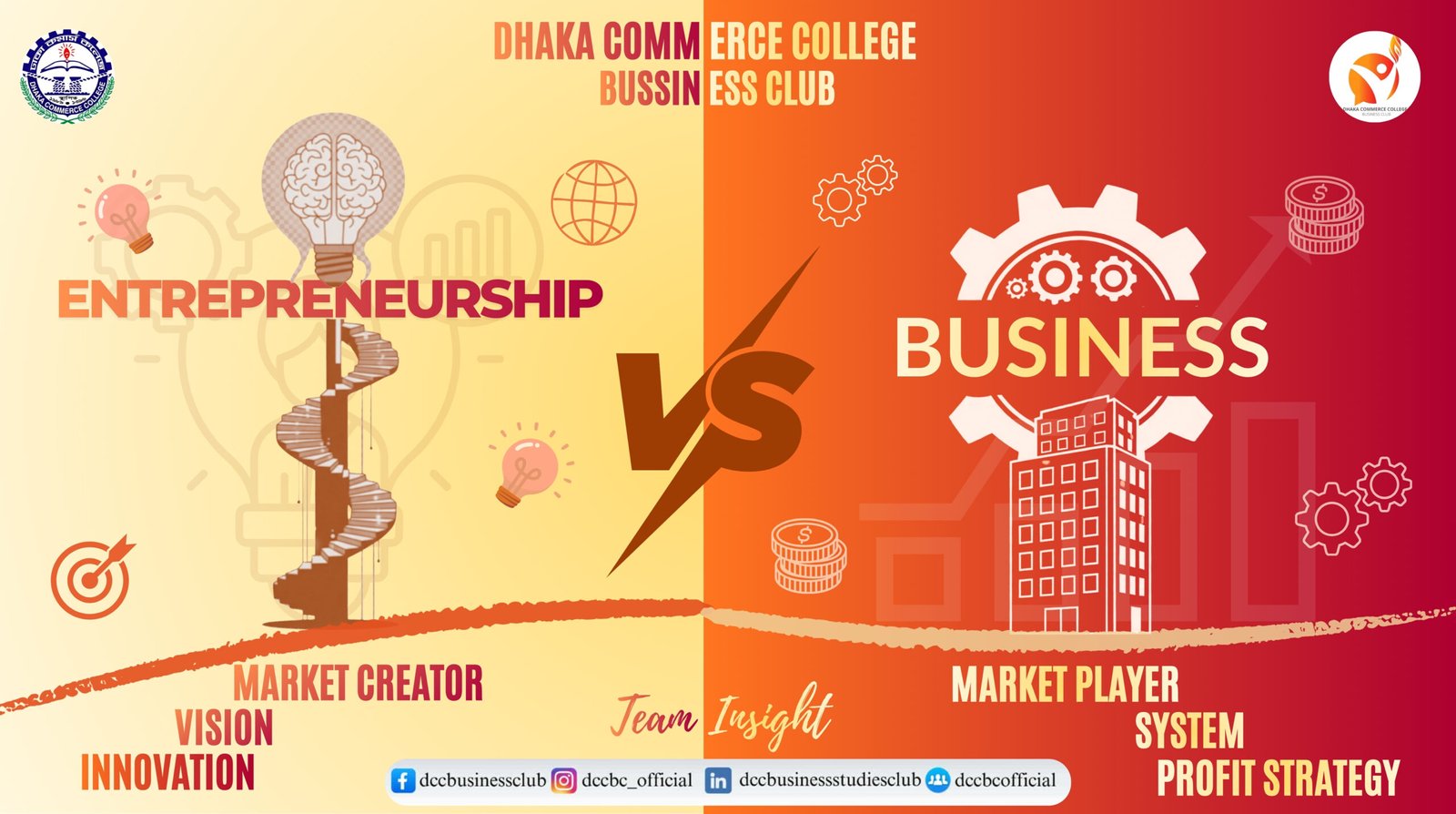
Written by: Team Insight. (Hamzah Hossain Raiyan, Srijita Munsur Medha, Nowshin Atia Raisa, Anita Ibanth Prithe, Md. Maheen Ahmed, MDSodaful Islam.)
All rights reserved by DCC Business Club.
Entrepreneurship Vs Business
Although the terms “Entrepreneur” and “Business” are often used synonymously, they are actually two different aspects of the same economic world. Think of it this way, business is the engine that drives a car, but entrepreneurship is the spark that creates a whole new kind of engine.
1. Conceptual Foundations:
To understand the difference, we have to look at their roots.
Business (The Optimizer): Business is the process of making a profit by using a successful medium. We all know that the main purpose of business is to make a profit. All businesses register using that product or service. They don’t invent anything new. They just make the medium they use bigger.
Entrepreneurship (The Disruptor): An entrepreneur is someone who creates a way of doing business. It’s not just about selling, it’s about innovating. An entrepreneur looks at the grocery industry and says, “Why go to the store? Let’s build an app that delivers groceries by drone.” It’s rooted in problem solving and transformation.
(Source: Wikipedia)
2. The key difference:
The main differences between an entrepreneur and a businessman are markets, risk, and funding. Another big and important difference that completely separates these two things is ‘Thinking’. The main thought of a businessman is how to sell his goods quickly and make a profit. But the main idea of an entrepreneur is to invent a new product, to find a simple solution to a new problem.
The main differences are highlighted below.
(i) Market: A market is a place or area where the demand for goods or services is met.
A market is an important place for business and entrepreneurs.
Business (Market player): For a business, the market is a competitive field, a collection of potential buyers. They only deal with the products or services available in the market.
Entrepreneurship (Market Creator): From the perspective of a successful entrepreneur, the market is a collection of problems. Markets are created when people face a problem or need. The job of an entrepreneur is to come up with a new product or service that provides an improved or cost-effective solution to that problem.
(ii) Risk: Risk is the possibility of not getting the desired results in return for the time, money and effort invested. The nature of risk varies somewhat from the perspective of a businessman and an entrepreneur.
Business Risk: A businessman usually operates within an established model, so his risks are mainly operational and external. But if new competitors enter the market, there is a fear of reduced profits, inflation, and interest rates may increase. But the risks of business are relatively controlled and stable.
Entrepreneurial Risk: An entrepreneur creates something new from scratch, so his risk is much more personal and profound. Because most entrepreneurs invest from their own funds. Moreover, there is also the fear of whether their new invention will be accepted. Again, it takes years to make an idea successful, which results in a lot of time.
(iii) Fund: When money is set aside for a specific purpose, it is called a fund. There is a difference between raising funds for business and entrepreneurship.
Business Funding: Business funding is the lifeblood of an organization. The owner raises funds through his own savings, profits earned from the business, or the sale of excess assets. Again, external sources such as bank loans, bond or debenture issues, and sale of shares in the stock market. Due to the wide range of business facilities, the funds of large business organizations are also huge.
Entrepreneurial Funding: For an entrepreneur, funding is not just money, but a tool to create opportunities. They raise this funding from their own savings and by borrowing from family and friends. Entrepreneurs use funds as a protective amulet. But entrepreneurs do not usually receive the benefits of loans from various financial institutions like businessmen, so their funds are small.
(Source: MASBA, GeeksforGeek)
3. Failure Dynamics: Why Do They Collapse?
Both can fail, but they crash for very different reasons.
Why Do Businesses Fail?
(i) Running Out of Cash: Money is the lifeblood of a business. Many fail because they spend more than they earn or can’t collect payments on time. If a shop buys too much stock but nobody buys it, they won’t have the cash to pay rent or salaries.
(ii) Not Giving Customers What They Want: Trends change fast. If a business keeps selling the same old things while customers move on to something better or newer, sales will drop. If you don’t adapt to what people actually want to buy, you lose to competitors.
(iii) Bad Management: A business is only as good as its team. If the boss is a poor leader or if employees are constantly arguing, work doesn’t get done. Internal drama destroys productivity and sinks the ship.
(Source: U.S Chamber of Commerce)
Why Do Entrepreneurs Fail?
(i) Ideas That Aren’t Realistic: Entrepreneurs often go after “big ideas” that sounds cool but aren’t useful. For example, inventing a high-tech gadget that no one actually needs. Innovation is great, but it must solve a real problem.
(ii) Growing Too Fast, Too Soon: Trying to scale a business without a solid plan is like building a house on sand. If a startup tries to become huge overnight without the right systems in place, it creates chaos. Eventually, the business collapses under its own weight.
(iii) Burnout: Many founders try to do everything themselves, working 24/7. Ignoring health and personal life leads to total exhaustion. When the founder burns out and gives up, the whole vision dies with them.
(Source: Forbes)
4.The Successors: What They Follow?
There are many companies in the world today that were created through initiative. They are now at the pinnacle of the economy by creating new means to solve new problems for people. Among them is Steve Jobs, founder of Apple, the company that makes the iPhone, introducing a new medium the smart phone, which can provide more information than previous phones.
After the invention of the Internet, it became clear that a medium was needed to find information. Then, Larry Page and Sergey Brin founded Google. Currently, there are organizations in our country that have started with the aim of solving many problems, such as 10 Minute School, founded by our beloved Ayman Sadiq. The goal of which was to bring students education online. There are also some other entrepreneurs like Fahim Mashroor, Co-founder of ‘BDjobs.com’ (Bangladesh’s leading job portal), Waseem Alim Founder of ‘Chaldal’, Hussain M. Elias of ‘Pathao’ and Kamal S.Quadir, Founder of ‘CellBazaar’ and CEO of ‘bKash’, a major mobile financial service. Their main task was to create simple solutions. (AI Overview)
5. The Identity Crisis: Why Do We Confuse Business with Entrepreneurship?
In Bangladesh, many people mistake a business person for an entrepreneur. This confusion happens because of our education system, our culture, and our general outlook on work. Most people think both are simply about making money. While making a profit is important for both, there is a big difference in how they start and grow. Our current education system encourages us to follow traditional business paths rather than teaching us how to be true entrepreneurs. Usually, an entrepreneur eventually becomes a businessman. Once a new idea becomes successful, the person often stops innovating and starts focusing on keeping the business running and expanding it. We see this often in Bangladesh. For example, ‘Pran’ was an entrepreneur when they first introduced bottled drinks to our country. It was a new idea and a convenient solution. Today, however, many other companies do the same thing. ‘Pran’ is no longer innovating that specific market they are now a major market player. A real entrepreneur doesn’t stop at one goal. Consider Elon Musk, the founder of ‘Tesla’. He doesn’t stay stuck on one project. Once one company is successful, he moves on to the next big challenge. This constant drive for new ideas is what makes someone a true entrepreneur. In Bangladesh, people are finally starting to value entrepreneurship. We must remember that, “A business starts with money, but entrepreneurship starts with the power of creativity and willpower”.
6.Our Mission: Steps to Success
The next generation will be technology driven. Solutions to any problem will be found through technology. Therefore, businesses and entrepreneurship must also be tech centered.
(I) Human + AI: In the future, AI won’t be able to use humans because humans will be the one to use AI for their beneficial and it will empower them. Tasks will be solved through AI, allowing entrepreneurs and business owners to gain insights and knowledge on subjects previously unknown to them.
(ii) Digital Marketing: Through Facebook, Instagram and Google Ads, it is possible to reach target audiences at a very low cost. This allows for a deeper understanding of the actual customer base.
(iii) Automation: Robotics and software automation are enabling the production of more goods in less time with higher accuracy.
(iv) Digital Payment: Transactions have becoming more and more easier and faster through platforms like bKash, Nagad, or online banking.
(v) Cyber Security: Utilizing advanced security software to protect business data and maintain the confidentiality of an entrepreneur’s new projects.
At last Business is just a flow of cash and product. But Entrepreneurship is the system we crave and die to build for. So be what you want!